NVIDIA Robo AI: Transforming Physical AI and General-Purpose Robotics
Physical AI represents the next major frontier in technology. It brings artificial intelligence out of the digital cloud and into the real world. NVIDIA robo AI ecosystems bridge simulation and physical deployment with unprecedented speed. Robots must perceive, learn, and act safely in dynamic human environments. Advanced hardware and software pipelines make this transition possible today.
Industrial automation relies heavily on scalable development tools. The NVIDIA Isaac platform provides comprehensive frameworks for modern developers. Engineers can build, test, and optimize intelligent machines before deploying them physically. Let us explore how these breakthroughs reshape modern robotics.
Industry Insight: Recent market analysis indicates that over 70 percent of industrial robotics projects experience delays due to inadequate physical simulation testing. Advanced simulation platforms like Isaac Sim reduce these deployment bottlenecks by up to 50 percent through synthetic data generation.
What is NVIDIA Robo AI?
NVIDIA robo AI refers to an integrated hardware and software stack designed to build autonomous machines. It combines accelerated computing, physical simulation, and generative AI models. These tools empower robots to understand complex surroundings and execute tasks naturally.
At its core, this ecosystem solves the data scarcity problem in robotics. Real-world training takes time and carries high financial risks. Simulation environments allow algorithms to train across millions of virtual scenarios safely. Developers leverage cutting-edge AI solutions to scale these autonomous capabilities across various industrial sectors.
How Does the NVIDIA Isaac Platform Work?
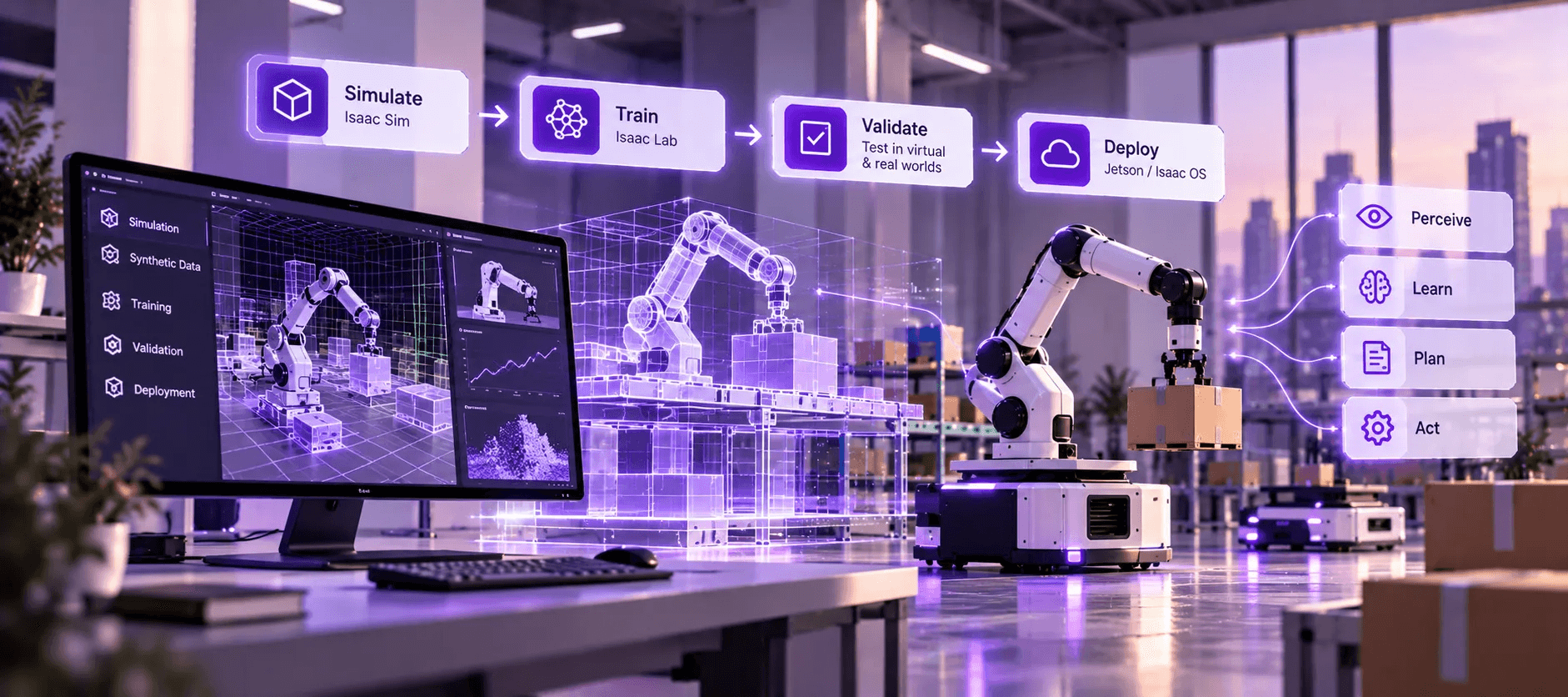
The NVIDIA Isaac platform operates through a continuous simulation-to-real workflow. It connects high-fidelity physics engines with advanced policy training tools. Engineers move seamlessly from virtual design to physical execution.
The workflow follows four distinct operational stages. First, developers build photorealistic virtual worlds inside simulation engines. Second, reinforcement learning algorithms train robot policies at scale. Third, ROS 2 integration ensures smooth communication with hardware drivers. Finally, the system deploys onto edge computing units like Jetson modules.
Key Takeaways: The NVIDIA robotics stack streamlines development by combining Isaac Sim for virtualization, Isaac Lab for policy training, and Isaac ROS for real-time edge deployment. This eliminates traditional integration friction.
NVIDIA Isaac Platform Simulation-to-Real Workflow
| Workflow Stage | Core Tool or Framework | Operational Function |
|---|---|---|
| Virtual World Creation | Isaac Sim | Build photorealistic virtual simulation environments for safe testing. |
| Policy Training | Isaac Lab | Train reinforcement learning robot policies at massive scale. |
| Hardware Communication | ROS 2 / Isaac ROS | Ensure smooth deployment and communication with physical hardware drivers. |
| Edge Deployment | Jetson Modules / Isaac OS | Deploy optimized runtimes onto edge computing units for physical execution. |
Foundational Assessment Phase for Robotics Integration
Successful robotics adoption requires a rigorous initial assessment phase. Organizations must evaluate existing operational workflows before writing a single line of code. Map out physical bottlenecks, safety hazards, and repetitive manual tasks.
Conduct comprehensive pain-point surveys with frontline operators. Establish baseline performance metrics such as cycle times and error rates. This baseline data prioritizes capital expenditure and targets measurable return on investment from day one.
Action Checklist for Assessment:
- Map current physical workflows and material transport paths.
- Identify high-risk tasks that threaten worker safety.
- Document exact throughput metrics and error frequencies.
- Establish a cross-functional robotics steering committee.
Use Case Prioritization for General-Purpose Robots
Not all automation opportunities deliver equal business value. Organizations must score potential use cases by impact and technical feasibility. Impact includes time saved, risk reduction, and overall client value.
Feasibility measures technology readiness, data availability, and implementation complexity. High-impact and high-feasibility candidates serve as ideal first-wave pilots. Target predictable environments before attempting unstructured outdoor navigation.
To deepen your understanding of how intelligent machines perceive their surroundings, explore our guide on computer vision fundamentals. Visual perception forms the bedrock of modern robotic navigation.
Governance Beyond Security in Physical AI
Operational governance goes far beyond basic cybersecurity protocols. Physical AI systems operate in shared human spaces where safety is paramount. Document a formal governance framework outlining acceptable use rules and data handling boundaries.
Assign clear accountability for final autonomous outputs and physical actions. Ensure compliance with emerging regulatory standards for collaborative robotics. A dedicated robotics committee or safety officer must oversee these critical policies.
Survey Insights: According to recent enterprise automation surveys, 85 percent of deployment executives cite safety governance and fail-safe protocols as the primary deciding factors for scaling physical AI fleets.
Validation and Fact-Checking Protocols for Robot Policies
General-purpose robot policies require rigorous multi-layer review before real-world deployment. Testing must verify general-purpose policies across diverse embodiments without visual domain overlap. This prevents unexpected failures in unfamiliar environments.
Verify simulation training against primary physical data and edge-case scenarios. Ensure strict alignment with international quality and safety standards. Skipping validation can result in catastrophic hardware collisions and costly operational downtime.
Structured Training Protocols for Technical Teams
Successful adoption depends on structured training programs for internal teams. Build comprehensive modules covering practical tool usage and simulation workflows. Teach engineers how to troubleshoot synthetic data pipelines and edge deployment errors.
Deliver content through flexible formats like lunch-and-learns and on-demand modules. Cultivate internal champions to guide teams through complex migration steps. Awareness of system limitations prevents over-reliance on automated decisions.
ROI Measurement and Business Model Evolution
Connect pilot success directly to measurable business metrics. Track reductions in cycle times, labor costs, and error frequencies. Quantifying these metrics justifies further investment in advanced automation infrastructure.
Extend metrics beyond internal efficiency into strategic market positioning. Evolve pricing models to capture value from faster delivery times and enhanced accuracy. Partner with industry leaders to implement scalable artificial intelligence solutions tailored to your sector.
Your NVIDIA Robo AI Implementation Roadmap
Consolidate your automation strategy into a structured multi-phase rollout. Follow these sequential phases to ensure seamless adoption from simulation to production deployment.
Phase 1: Assess and Strategize
Map operational workflows, identify safety bottlenecks, and establish baseline performance metrics. Expert Tip: Involve frontline operators early to capture accurate daily friction points.
Phase 2: Pilot and Learn
Deploy high-impact, high-feasibility use cases within Isaac Sim environments. Expert Tip: Focus initial tests on structured indoor tasks before moving to complex environments.
Phase 3: Govern and Secure
Establish clear safety rules, data handling boundaries, and accountability structures. Expert Tip: Appoint a dedicated robotics safety officer to oversee compliance.
Phase 4: Measure and Refine
Track cycle times, cost reductions, and error rates against initial baseline data. Expert Tip: Continuously feed real-world operational data back into simulation models.
Phase 5: Scale and Evolve
Expand deployment across full enterprise fleets and evolve business models. Expert Tip: Invest in ongoing team training to maintain technological leadership.
NVIDIA Robo AI Implementation Roadmap Phases
| Phase Number | Phase Name | Core Action Focus |
|---|---|---|
| Phase 1 | Assess and Strategize | Map operational workflows, identify safety bottlenecks, and establish baseline performance metrics. |
| Phase 2 | Pilot and Learn | Deploy high-impact, high-feasibility use cases within virtual simulation environments. |
| Phase 3 | Scale and Optimize | Expand deployment across broader physical environments while refining system efficiency. |
Conclusion
NVIDIA robo AI technologies redefine the boundaries of physical automation. By combining advanced simulation, robust developer tools, and strict governance, organizations can deploy intelligent machines safely. The journey requires careful assessment, disciplined piloting, and continuous measurement.
Embracing physical AI positions businesses at the forefront of modern industry. Start your transformation today by mapping out high-impact workflows and leveraging cutting-edge simulation tools. Partner with experienced specialists to turn your autonomous vision into reality.