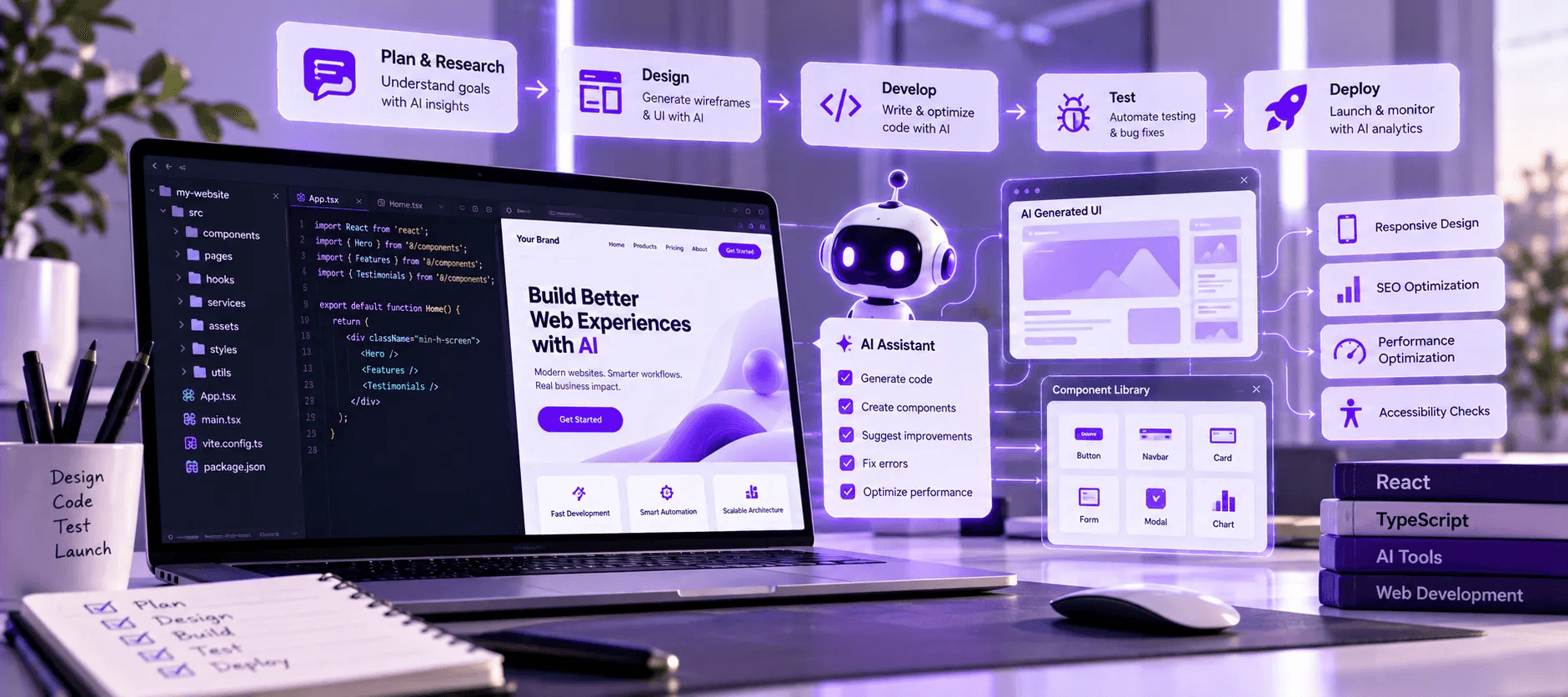
Website Development with AI: The Complete Guide for 2026
Website development with AI has transformed from an experimental tech trend into the core standard for digital creation. When building modern web platforms, developers and business leaders face a shifting landscape where code-enabled language models, automated testing, and intelligent design systems accelerate delivery times. You might wonder how artificial intelligence actually changes your daily workflow and project costs. Here is the truth: adopting AI in web projects is no longer just about writing code faster; it is about building scalable, future-ready digital foundations that adapt to user behavior.
The web ecosystem evolves rapidly, driven by intelligent agents and generative design frameworks. Whether you manage an enterprise e-commerce platform or a startup landing page, understanding where and how to apply these tools determines your market success. In this guide, we break down the foundational assessment, strategic use cases, governance frameworks, and multi-phase implementation roadmaps required to master AI-assisted web creation.
What is Website Development with AI?
Website development with AI is the practice of using machine learning models, generative design tools, and intelligent automation to plan, code, test, and optimize web applications. It streamlines everything from initial wireframing to backend logic and continuous performance tuning. Rather than replacing human developers, AI acts as an advanced force multiplier that handles repetitive syntax generation and layout iteration.
Modern development teams rely on these technologies to reduce time-to-market and eliminate human error in routine tasks. The core components of an AI system blueprint map out user value, application logic, and data infrastructure before a single line of code goes live. This structured approach ensures that technology choices serve explicit business goals rather than chasing fleeting tech trends.
How Does AI Fit Into the Foundational Assessment Phase?
Before adopting any new technology, your organization must conduct a rigorous foundational assessment to map workflows, identify bottlenecks, and establish baseline metrics. Skipping this step leads to unfocused tool adoption and wasted engineering hours. You need a clear picture of your current web architecture and operational inefficiencies before introducing automation.
Your assessment phase should begin with comprehensive workflow mapping across your entire development lifecycle. Survey your engineering and design teams to pinpoint exact pain points, such as slow asset generation, tedious state management setup, or repetitive testing cycles. Use these baseline metrics to prioritize your investments and target tangible return on investment from day one. When you ground your strategy in concrete data, you ensure that every tool you introduce solves a genuine operational bottleneck.
- Map existing web development pipelines from design handoff to production deployment.
- Conduct internal pain-point surveys with front-end and back-end engineers.
- Establish quantitative baseline metrics, including average sprint velocity and deployment frequency.
- Identify high-friction areas where manual coding or asset creation slows delivery.
Foundational Assessment & Workflow Mapping Phase
| Assessment Stage | Operational Focus | Key Objective |
|---|---|---|
| Workflow Mapping | Analyze entire development lifecycle | Identify operational bottlenecks and inefficiencies before tool adoption. |
| Team Surveying | Gather input from engineering and design teams | Pinpoint exact pain points like slow asset generation and tedious tasks. |
| Baseline Metrics | Establish current performance benchmarks | Measure future time savings and efficiency gains accurately. |
How Should You Prioritize Use Cases for Maximum Impact?
You prioritize AI use cases by scoring opportunities against impact and feasibility criteria to identify high-value pilot projects. Impact measures time saved, risk reduction, and end-user value, while feasibility assesses technology readiness, data requirements, and integration complexity. By plotting these factors on a matrix, you can isolate high-impact and high-feasibility candidates for your first wave of pilots.
Starting with manageable pilot projects allows your team to build confidence without risking core business operations. For example, automating routine CSS refactoring or generating placeholder copy for staging environments offers quick wins with minimal risk. As your team masters these initial applications, you can expand into more complex architectural planning and automated security scanning.
- Score potential AI integrations based on measurable business value versus technical complexity.
- Target low-risk, high-frequency tasks like unit test generation for your initial pilot.
- Avoid tackling mission-critical backend refactoring until your team masters basic prompt engineering and output validation.
AI Use Case Prioritization Matrix
| Evaluation Criteria | Core Focus | Strategic Outcome |
|---|---|---|
| Impact | Measure time saved, risk reduction, and end-user value | Isolate high-value opportunities for development teams. |
| Feasibility | Assess technology readiness, data requirements, and complexity | Determine technical viability for immediate implementation. |
| Pilot Selection | Plot impact versus feasibility on a matrix | Select low-risk pilot projects to build team confidence without disrupting core operations. |
What Governance and Validation Protocols Do You Need?
Operational governance must be treated separately from technical security to ensure clear accountability across your web development lifecycle. Your governance framework should document acceptable use rules, data handling boundaries, and clear ownership roles assigned to a dedicated committee or senior engineering leads. Without these boundaries, teams risk introducing compliance failures, intellectual property leaks, or insecure code into production environments.
Equally critical is establishing a mandatory multi-layer validation and fact-checking protocol for all automated outputs. Never deploy AI-generated code or content without independent professional review and rigorous verification against primary sources. Skipping these validation steps often results in subtle logic bugs, broken dependencies, or copyright infringements that damage brand trust.
How Can Structured Training Drive Successful Adoption?
Successful technology adoption requires a structured training protocol that covers practical tool usage, effective prompting workflows, and governance rules. Busy professionals need flexible delivery formats like lunch-and-learn sessions, on-demand modules, and mentorship from internal technical champions. When teams understand both the capabilities and the limitations of their tools, they avoid common pitfalls like over-reliance on unverified code.
Your training program should explicitly address common failure modes such as model hallucinations, security blind spots, and algorithmic bias. By teaching developers how to critically evaluate generated solutions, you foster a culture of responsible engineering. To explore how advanced digital solutions come together, you can examine our comprehensive development expertise across modern web platforms.
How Do You Measure ROI and Evolve Your Business Model?
Measuring return on investment in AI-driven web development extends far beyond internal time savings and reduced sprint cycles. You must track key metrics such as deployment turnaround speed, bug reduction rates, and overall client satisfaction scores. For broader digital transformation insights, you can review our guide on future web development trends that shape modern enterprise strategies.
Beyond internal efficiency, successful implementation allows businesses to evolve their pricing and service delivery models. Instead of billing strictly on hourly development time, agencies can transition toward value-based arrangements and faster project turnarounds. This shift improves profit margins while positioning your brand as an agile, forward-thinking market leader. For specialized artificial intelligence projects, partnering with our dedicated AI solutions team ensures seamless execution from strategy to deployment.
Your Website Development with AI Roadmap
Implementing artificial intelligence in your web projects requires a structured, phased approach that minimizes disruption and maximizes long-term value. Below is your step-by-step roadmap for sustainable transformation:
1. Assess and Strategize: Map your current web development workflows, identify specific operational bottlenecks, and establish clear baseline metrics. Expert tip: Involve front-end and back-end engineers early to ensure your assessment captures accurate daily pain points.
2. Pilot and Learn: Score potential use cases by impact and feasibility, then launch low-risk pilot projects like automated unit testing. Expert tip: Keep your first pilot small and isolated to measure velocity gains accurately before expanding scope.
3. Govern and Secure: Establish a formal governance framework that defines acceptable use rules, data handling boundaries, and clear operational ownership. Expert tip: Separate technical security policies from general operational guidelines to avoid compliance gaps.
4. Measure and Refine: Track key performance indicators including turnaround speed, code quality, and team time savings to validate your investment. Expert tip: Review pilot metrics monthly to adjust tool configurations and address emerging skill gaps.
5. Scale and Evolve: Expand successful AI workflows across larger teams and explore innovative business models like value-based client pricing. Expert tip: Continuously update your training protocols to keep pace with rapid advancements in generative web technologies.
Website development with AI represents a fundamental shift in how digital experiences come to life. By combining rigorous foundational assessments, structured use case prioritization, and strict validation protocols, your organization can build faster and smarter without sacrificing quality. Embrace these strategies today to secure a competitive advantage in the modern web landscape.